
Three strategies to get your firm AI-recommended
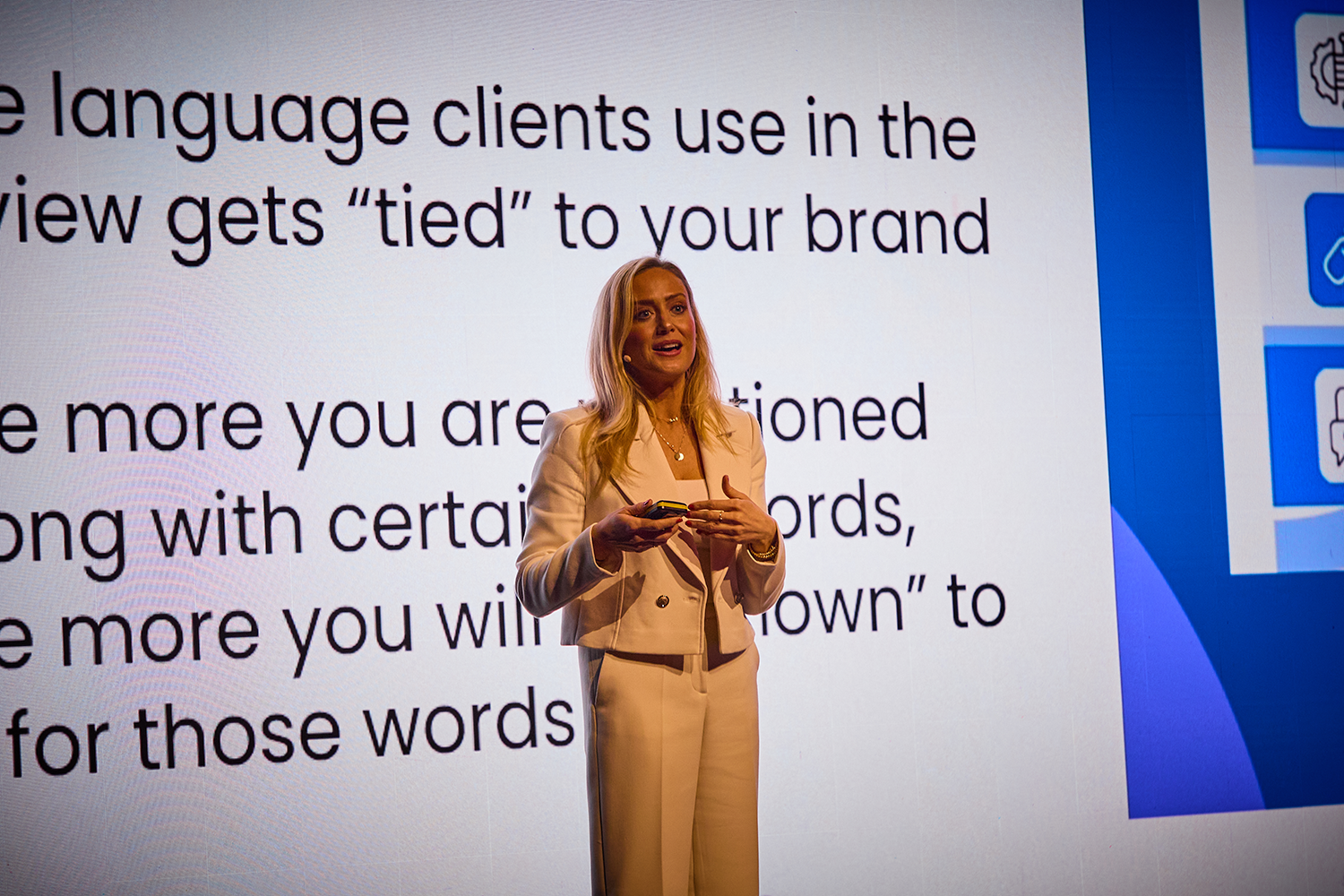
Samantha Russell was speaking at Fundment LIVE - The Adviser Edge in London on 29 January 2026
The digital landscape for financial planners has fundamentally shifted, and most haven't noticed yet, according to digital marketing specialist Samantha Russell.
Speaking at Fundment LIVE – The Adviser Edge, Russell explained that, for 25 years, Google was a key gateway to new clients. Now, AI search tools are rewriting the rules entirely – and planners who don't adapt risk becoming invisible.
This isn't hyperbole; it’s already happening. Website traffic across all industries is down 33%, and 60% of searches now end without a single click. People aren't scrolling through pages of links anymore. They're asking ChatGPT, Perplexity, or Google's AI Overview for recommendations and getting just three to five answers.
For potential clients searching for services online, if your firm isn't one of them, you might as well not exist.
The visibility crisis no one's talking about
The shift mirrors a historical precedent that should concern every business owner, Russell said, speaking to an audience of 400 financial planning professionals on 29 January 2026.
When the Library of Alexandria burned, centuries of accumulated knowledge vanished overnight. The ideas weren't necessarily less valuable; they simply became undiscoverable.
“A new type of library is being built,” explained Russell, a digital marketing strategist who has worked with planning firms across the US and UK for over a decade. “For the last 25 years, Google was the digital library of our time. And that is all being turned upside down by AI search.”
The question planners need to ask themselves is: as this new library takes shape, how do we ensure our business remains on the shelves?
The answer isn't straightforward, partly because different AI tools recommend different businesses for identical queries. In one test, a detailed search for a financial adviser – complete with specific needs around estate planning and family considerations – yielded completely different results across platforms. ChatGPT recommended certain firms, Google's AI suggested six others (with only one overlap), and Perplexity provided yet another set of names.
What's revealing, Russell explained, is the reasoning these large language models provide for their recommendations. They cite comprehensive services, strong local presence, fee-only approaches, reputation and client reviews, and (critically) fit for the specific client profile described in the search.
Why traditional SEO is dead
The old SEO playbook doesn't work anymore, Russell explained. Ranking tenth on Google? You're invisible. Even Google is limiting results to no more than 10 links per page, and most people never scroll past the AI summary at the top anyway.
The growth of AI search tools has been exponential. ChatGPT crossed one billion weekly searches in late 2025 – that’s 18% of the world's population using these tools regularly.
AI search is predicted to overtake traditional search by 2028, though that timeline may be conservative given current adoption rates.
But there's counterintuitive good news, Russell said: whilst overall website traffic is down, conversion rates are significantly higher. When someone receives your name as one of three recommendations after a detailed conversation with ChatGPT about their specific financial situation, they're far more qualified than someone who clicked a random link on page two of Google results.
Russell has been tracking this shift for 18 months, regularly asking audiences whether they've received leads from ChatGPT. Initially, almost no hands went up. Now, more advisers are reporting leads, often without doing anything deliberate to generate them.
Three strategies to become AI-recommended
The path to visibility in AI search comes down to three core strategies, each requiring consistent effort rather than one-off optimisation.
1 Get reviews from real clients
This is the single biggest indicator AI tools examine when deciding which businesses to recommend. They're looking for legitimacy, and client reviews provide that social proof.
“We have heard so much about trust today,” Russell said, referencing a session at The Adviser Edge by trust expert Rachel Botsman. “In the old world, we could manipulate the system in a lot of ways to get recommended. The playing field is being levelled. And now AI is saying we want to recommend legitimate businesses that consumers have had good experiences with.”
The algorithms don't just count stars. They analyse the total volume of reviews (more reviews suggest more legitimacy) and, crucially, the keywords within them. If you want to be known as the adviser in Cambridge who works with small business owners on succession planning, you need reviews that mention those specific terms in natural language.
After being referred to a financial adviser, 83% of consumers want to read reviews before making contact. Yet in the US, only 9.3% of advisers have published reviews online. That gap represents both a problem and an opportunity, Russell said.
2 Build a reputation AI cannot ignore
Beyond reviews, AI tools prioritise what's called ‘earned’ media – quotes in publications, podcast appearances, and links from external sources back to your website. All that time spent building your public profile matters now, Russell said.
The top domains that large language models reference reveal something interesting: Reddit, LinkedIn, Wikipedia, Medium, and YouTube dominate the list. These are all platforms where any planner can create and share content.
LinkedIn deserves particular attention, Russell explained. The AI tools increasingly use it as a source, but there's a distinction that matters: they source from LinkedIn articles, not just standard posts. Converting your posts into articles makes them more likely to be referenced.
For finance-specific queries, AI tools also look to Investopedia and NerdWallet. Contributing to these platforms, if possible, can build valuable backlinks and authority.
One strategy that's made a surprising comeback: press releases. For years, marketers dismissed them as outdated. AI loves them, Russell said. Creating a press release about a new service offering or specialisation can quickly signal to AI tools that you're relevant for specific searches.
Another approach is appearing on other people's podcasts or YouTube channels rather than creating your own. This requires less effort and, because it's earned media rather than owned content, carries more weight with AI algorithms.
3 Format your content for AI consumption
The technical aspects of how you structure content matter enormously, even if you're not personally implementing them.
The shift from SEO (search engine optimisation) to AEO (answer engine optimisation) represents a fundamental change in approach. You're no longer trying to rank for broad keywords like ‘financial adviser London’. You're trying to be the best answer to very specific questions.
“We're not trying to rank for everyone,” Russell said. “We want to be the best answer for a very specific niche.”
This means formatting content as questions and answers, because that's how people interact with AI tools. Blog post titles should be questions. LinkedIn posts should start with questions. The more your content mirrors the conversational way people query AI, the better.
Schema markup – structured data that helps AI understand your content – is essential, Russell explained. Whilst you don't need to learn coding, whoever manages your website should know how to implement it, particularly for FAQ pages.
Speaking of which: FAQ pages should appear at the bottom of nearly every page on your site. If you have a page about estate planning, include frequently asked questions about estate planning at the bottom. If you have a page about working with young families, add relevant FAQs there too.
Critically, these FAQs should use the exact language your clients use, not industry jargon. Don't rewrite questions in your own words. Use the actual phrasing clients employ when they ask about these topics.
The format of answers matters as well. AI-generated responses typically use short, bulleted points. Long paragraphs don't perform well. Make content easy to scan and digest quickly.
A case study: Drucker Wealth
Drucker Wealth, a firm specialising in Amazon, Google, and Meta employees, implemented these strategies with measurable results, Russell said. They wanted to rank higher when people searched for planners who understand the specific benefit packages at these companies.
They created dedicated pages for each target company, filled with specific questions employees at those companies actually ask: “What is Amazon's RSU vesting schedule?” Rather than dense paragraphs, they used bullet points and short, scannable sections.
At the bottom of each page, they included FAQs specific to that company's employees. They also added a lead magnet (a downloadable guide about restricted stock units) asking only for name and email address, not phone number.
Alongside the content strategy, they collected Google reviews from clients and added those reviews to their website (whilst linking to the full review platform for compliance). They particularly highlighted reviews from employees at their target companies.
The result: when someone asks AI: ‘I work at Amazon, have an Amazon 401(k) and some RSUs, who's a financial adviser I should work with?’, Drucker Wealth now appears prominently in the results.
The urgency of acting now
AI systems are being trained right now, Russell explained. They're learning which businesses to reference and which to ignore. This isn't a problem for next year; it’s happening in real time.
“The best answer isn't always the one that's currently being shown. The best business isn't always the one that's being shown,” Russell said. “Just like that Library of Alexandria burned to the ground and some of those ideas were never surfaced again... you don't want that to be your business in a year or two.”
One particularly important consideration: AI tools have a strong recency bias. Being quoted in an article six months ago isn't enough. The algorithms favour recent mentions, recent reviews, recent content. This requires ongoing effort, not a one-time optimisation project.
For firms with multiple planners, individual presence matters more than firm-level branding. When people search for a ‘financial adviser’ or ‘financial planner’, AI tools specifically look for individual people, not large institutions. Each planner should have their own profile, their own reviews under their name, and their own digital presence.
The playing field is being levelled in some ways, Russell said – you can’t game the system as easily as you could with traditional SEO. But it's also creating new winners and losers based on who adapts quickly. The planners who understand these dynamics and implement them consistently will capture an increasingly large share of new client enquiries.
Samantha Russell was speaking at Fundment LIVE - The Adviser Edge, an event for financial planning professionals, which took place at HERE at Outernet in London on 29 January 2026.
To download a PDF containing all the key highlights from Fundment LIVE - The Adviser Edge 2026, click here.
Samantha is Chief Evangelist at FMG Suite.