
A mistake planners make: confusing risk with trust
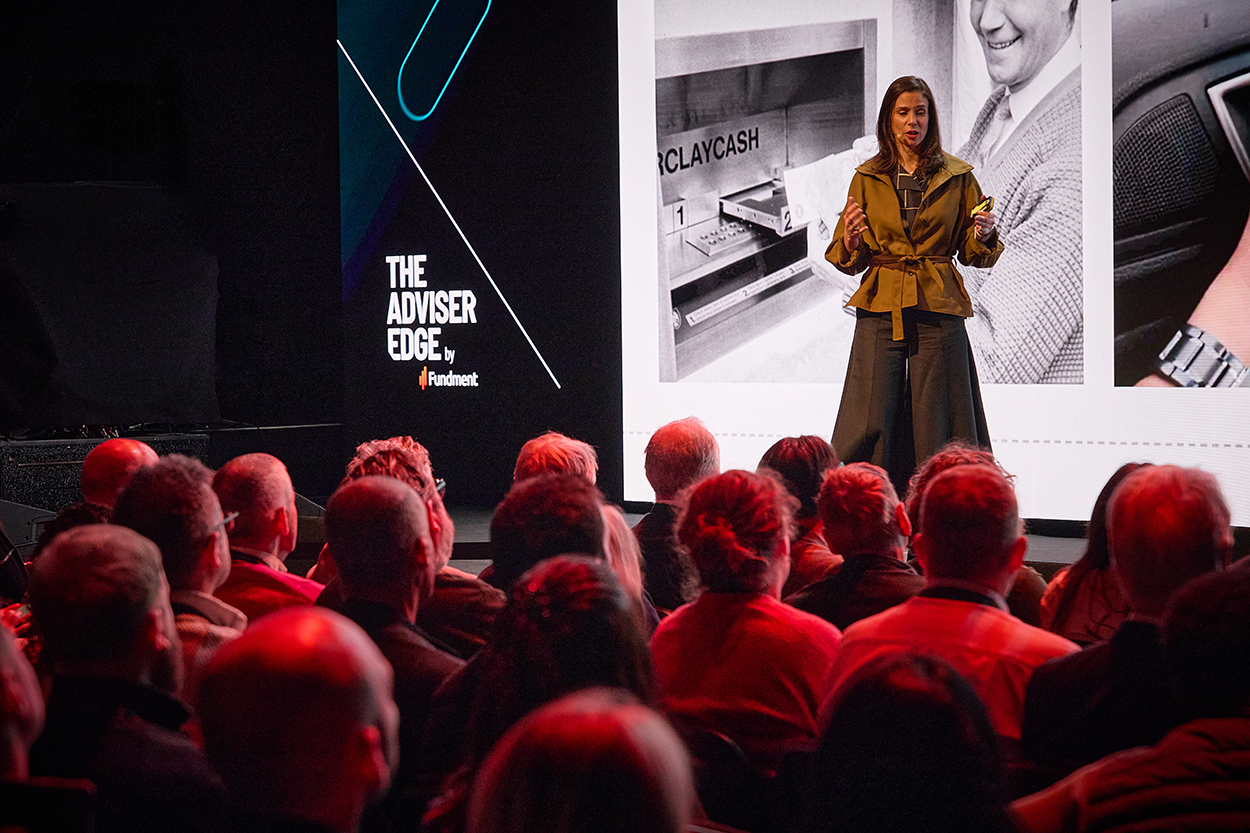
Rachel Botsman speaking at Fundment LIVE - The Adviser Edge in January 2026
Rachel Botsman has spent almost two decades studying trust, and she's noticed something odd about financial services: most professionals think they're building trust when they’re actually managing risk.
Speaking at Fundment LIVE – The Adviser Edge last month, Rachel laid out a framework that challenges how the industry approaches client relationships. Her central argument? Trust and risk are different currencies, and confusing the two can create a disconnect in planner-client relationships.
Two currencies; two conversations
“You have two currencies that are continually flowing," Botsman told an audience of 400 financial planning professionals. “Money is the currency of transactions. You can actually enable a transaction without a lot of trust. But trust is the currency of interactions. You can't pay people to have a relationship with you.”
The distinction matters, Botsman argued, because financial services professionals default to what's easier to manage: risk. They focus on probability, compliance, control, and protection. These are essential parts of the job, but they don't go far enough to nurture genuine relationships.
Trust operates in a different space entirely. It lives in uncertainty, creates feelings of empowerment and possibility, and enables people to move forward without complete information. As Botsman puts it: “Trust is a confident relationship with the unknown.”
This isn't just theoretical. When advisers confuse risk mitigation with trust building, they end up having the wrong conversation at the wrong time with clients who need something else entirely.
The ‘trust leap’ problem
Botsman introduced the concept of ‘trust leaps’. These are moments when financial planners ask clients to take a risk, do something new, or do something differently. Restructuring a portfolio. Investing in a new product. These are all trust leaps, and planners may be underestimating how high and fast these leaps feel to clients.
To illustrate the point, she asked the room to unlock their phones and hand them to the person next to them for 30 seconds. The nervous laughter was immediate. Even in a safe environment, with visibility of what the other person was doing, for just half a minute, people felt uncomfortable.
“Think about this,” Botsman said. “You can see what that person's doing. This is a safe environment. It's 30 seconds and yet it still feels uncomfortable. And yet we think about the information that we ask people to hand over to us, often just in a form where they can't see why we're going to use it and how we're going to use it for.”
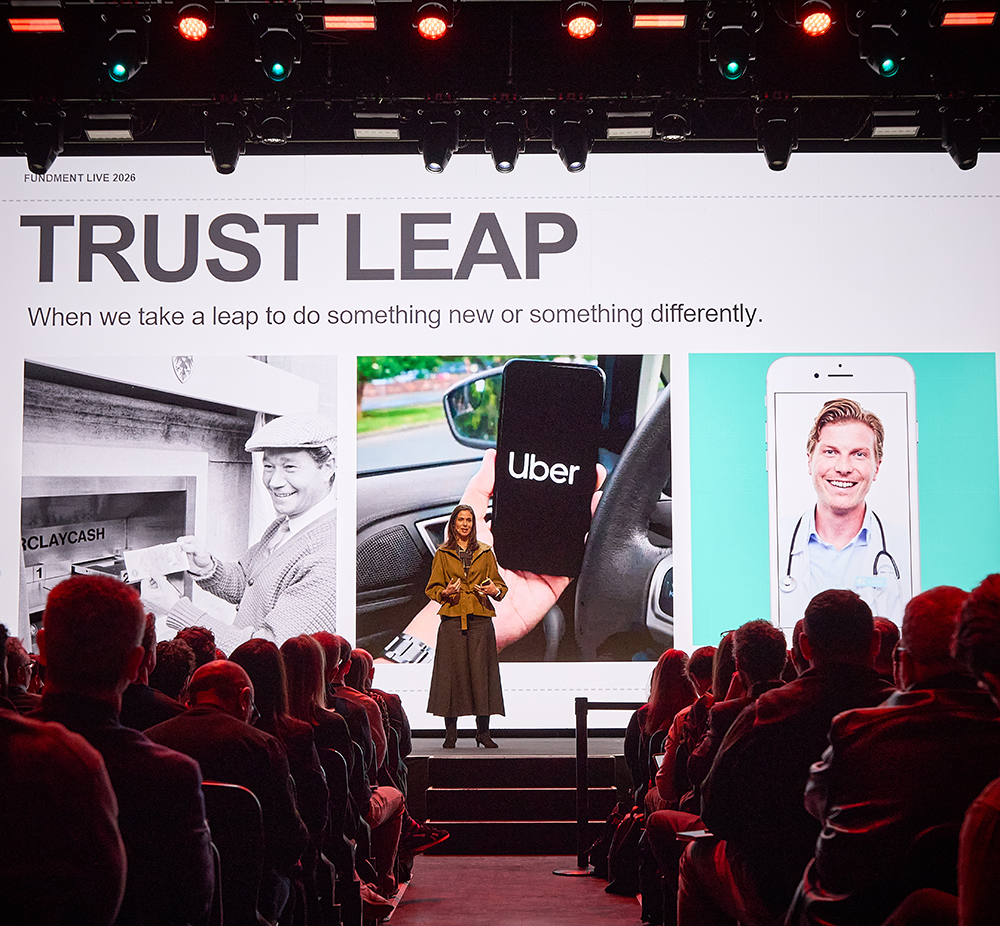
The exercise revealed something planners may not consider often: what trust state is my client in? Are they in a low trust state, signalling they're not ready to hand over information? Or are they in a high trust state, comfortable moving quickly?
Clients in low trust states aren't necessarily problematic, Botsman said. They're often the ones who end up forming the strongest relationships because they're asking planners to slow down, be more responsive, and provide more information before making decisions.
The four traits of trustworthiness
Rather than focusing on reputation – what people say about you – Botsman directed planners to focus on ‘trustworthiness’: how you show up and treat people. She broke this down into four key traits across two dimensions.
On the capability side: competence and reliability. Competence isn't just having the skills and experience to do what you say you'll do. It's also being honest when you don't know something. Reliability, meanwhile, is where most people wobble. It's about responsiveness, respecting time, not cancelling meetings, and consistency in behaviour over time.
On the character side: empathy and integrity. Empathy isn't just listening and caring; it’s the action and follow-through.
But if Botsman had to pick one trait that matters most in financial advice, it's integrity.
“It's like the compass, the North Star trait,” she said. “Integrity is the belief that that person's intentions and interests and motives align with my best interests. You think about your relationships with clients. It really comes down to that question: is this person going to represent my best interests and do they really understand what those interests are?”
When trust wobbles or breaks down, these four traits provide a diagnostic framework. Is it a competence issue? Does the client understand what you're capable of (and, crucially, what you cannot do)? Is it reliability? Or is it on the character side, related to empathy or integrity?
The control signal
One of the clearest signs that trust is breaking down is when clients start demanding control. At Fundment LIVE – The Adviser Edge, Botsman showed a video of a grandmother in a self-driving car, clearly in a low trust state. Early in the clip, the grandmother says something revealing: “Put me back in control.”
“This is the human response to uncertainty,” Botsman explained. “This is the human response to a trust leap that feels too high. Control is one of the first signs of a lack of trust.”
When clients start micromanaging, such as ringing constantly, asking excessive questions, demanding updates, they’re not being difficult, Botsman said. They're signalling that trust is wobbling. The same applies when clients go quiet, stop responding to communications, and eventually move to another adviser.
In these moments, planners have two options. They can increase trust, helping clients become comfortable with uncertainty. Or they can decrease risk, making the trust leap feel less high. Different situations require different approaches. The trouble comes from not being conscious about which strategy you're using.
Making the strange familiar
When introducing something new to clients, Botsman shared a principle from the history of cars: people don't actually like new things. They like the familiar done differently.
She showed a patent for the ‘Horsey Horseless’ – a wooden horse head designed to sit on the front of early automobiles so that when humans or horses saw the car coming, they'd think it was a horse and carriage. Absurd, perhaps, but it illustrates an important point about trust leaps.
“One of the key things to do when you are trying to get someone to take a trust leap is to make the strange feel familiar,” Botsman said. She's not suggesting planners put horse heads on the fronts of their offices, but the principle holds: when introducing something new, find ways to make it feel familiar.
The gender question
During the Q&A, an adviser raised research suggesting women were twice as likely to be dissatisfied with their financial planner than men, citing trust and communication issues. Men, apparently, were more concerned with investment performance.
Botsman acknowledged the stereotype – that men may look for capability signals whilst women look for character signals – but pointed out a more nuanced reality. Women advisers often have to over-index on capability first, particularly with male clients. If they lead with empathy, they risk being perceived as “soft” rather than competent. Male advisers sometimes have to lead with character because capability is assumed.
On the client side, women may arrive more readily at a place of vulnerability, admitting the emotional aspects of financial decisions and the support they need. With male clients, reaching that same place often requires more time and permission.
Botsman shared her own experience of a former adviser who repeatedly asked when her husband would join their meetings. “I think women have that experience all the time, that there is an assumption made about the financial situation,” she said. When she found a new adviser, his first question was: “What do you want from this relationship that you did not get from your other adviser?”
That question – asked before discussing money, portfolios, or products – signalled something important. The adviser wanted to understand what mattered to her, without assumptions.
Repairing broken trust
When trust breaks down, can it be repaired? Yes, Botsman said, and it can actually come back stronger. But planners need to stop thinking about trust repair broadly and start thinking about where it broke down specifically.
Go back to those four traits, Botsman said. Was it competence? Reliability? Empathy? Integrity? The mistake people make is trying to repair trust without identifying the specific breach.
If a client has become defensive or has slightly pulled away, trust can be repaired. If they've become completely disenchanted, it's time to walk away from the relationship.
The repair process often involves becoming better at setting expectations. “So many people are bad at setting expectations,” Botsman noted. These conversations are about understanding what expectation the client had that wasn't met, and resetting from there.
“If people feel seen and heard and feel like there's some kind of shift, you can start to move forwards again,” she said.
The lens you choose
Botsman left the audience with a question: How much of your day, your relationships, the decisions you make, is made through a risk lens (of probability), and how much through a trust lens (of possibility)?
“The very best planners, the very best people in any kind of relationships, the very best leaders, they know when they should be managing risk and when they really need to earn trust,” she said.
It's not an either-or proposition. But the distinction between them matters more than most planners realise. Risk management makes clients feel safe by reducing uncertainty. Trust building makes clients feel safe enough to move forward despite uncertainty.
One is about control and protection, the other about confidence and possibility. And knowing which conversation you're having – which one your client needs – is a powerful skill for planners to develop.
Rachel Botsman was speaking at Fundment LIVE - The Adviser Edge, an event for financial planning professionals, which took place at HERE at Outernet in London on 29 January 2026.
To download a PDF containing all the key highlights from Fundment LIVE - The Adviser Edge 2026, click here.
Rachel Botsman is a global authority on trust. Find out more.